How to read your astrocartography map (aka your natal map)
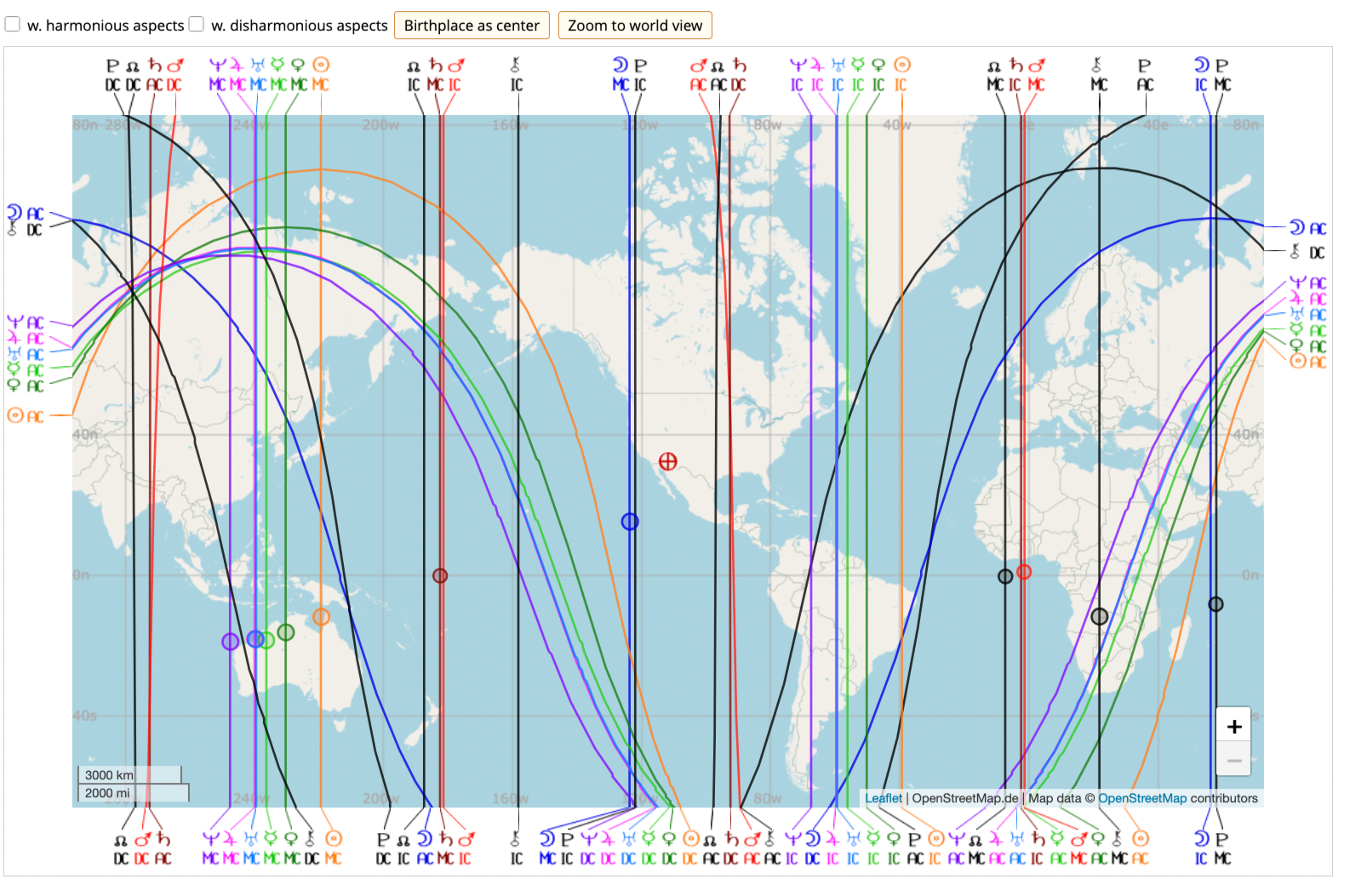
Astrocartography is a type of locational astrology (astrology of place) using a world map based on your birth sky!
Read on to find out:
What each planetary line or astrocartography line means (generally)
Why “good” planetary lines can feel bad
How to find supportive places for love, career, community, and feeling at home using your astrocartography map (aka locational astrology, astromapping, astrolocality, or your natal map)
What can you change with astrocartography?
How to look up your astrocartography map (for free!)
What the line colors and symbols mean on your free natal map
Keep in mind these are just the basics—there’s a LOT more to the story!
Astrocartography makes your synastry with planet earth visible so you can use it to navigate.
It’s your real-life treasure map!
While transits (and progressions) are always a factor, we have constant planetary energies in certain areas, and astrocartography helps us visualize these on a world map so we can strategize around them.
For a more complete recap on what astrolocality (aka astrocartography) is and why we use it, click here to read the introductory journal article!
or
Watch my 60-second explainer video on the practical basics of astrocartography including answers to questions like:
“What is astrocartography?”
“How does astrocartography work?”
“Is your astrocartography map the same in Tropical and Sidereal?”
“What can astrocartography change, and what does it not change?”
… by clicking here!
Read on to learn how to use your natal map to optimize your life!
Before we begin:
When I was brand-new to the concept of astrocartography (and instantly obsessed) I found a lot of pretty surface-level blog posts on how to read your astrocartography map that ultimately didn’t provide what I was really looking for because they lacked detail or it was spread over multiple posts.
I’ve provided a more in-depth, step-by-step beginner’s guide to reading your astrocartography map below in the hopes that you’re able to get better results and more clarity right off the bat than I was.
If what you see below is overwhelming, start with Sect and Essential Dignity, then skip down to line meanings—those should be doable (and helpful!) even if you’re not super-well-versed yet in astrology!
Step 1: Pull up your natal chart
You read that correctly, your natal chart is the foundation for the energy in your astrocartography map, so you’ll need to get your bearings there before diving into the map (it’s worth it, I promise!)
There are tons of places you can pull up your natal chart for free online:
Astro Dienst (astro.com)—also my fave for free astrocartography maps! You will need to select Whole Sign as the default is Placidus.
Astro Charts—if you’re a fiend for aesthetics, theirs are pretty and they include aspect lists below the chart. You will need to select Whole Sign as the default is Placidus.
… just to name a couple. It’s up to you which one you choose, but I’d recommend choosing one that offers the following options + selecting:
Whole Sign Houses (this is what I use as someone based in Hellenistic Astrology)
Detailed aspects (including how close the aspects are by degree or their strength)
Tropical (especially if you’re just starting out)
Prefer video? Pull up your birth chart + watch me recap steps 2-4 below:
Step 2: Determine Sect + which planetary team is on your side!
To determine your chart’s sect, look at your birth chart and find the ASC-DSC axis (it might be a little diagonal instead of perfectly level like the illustration below).
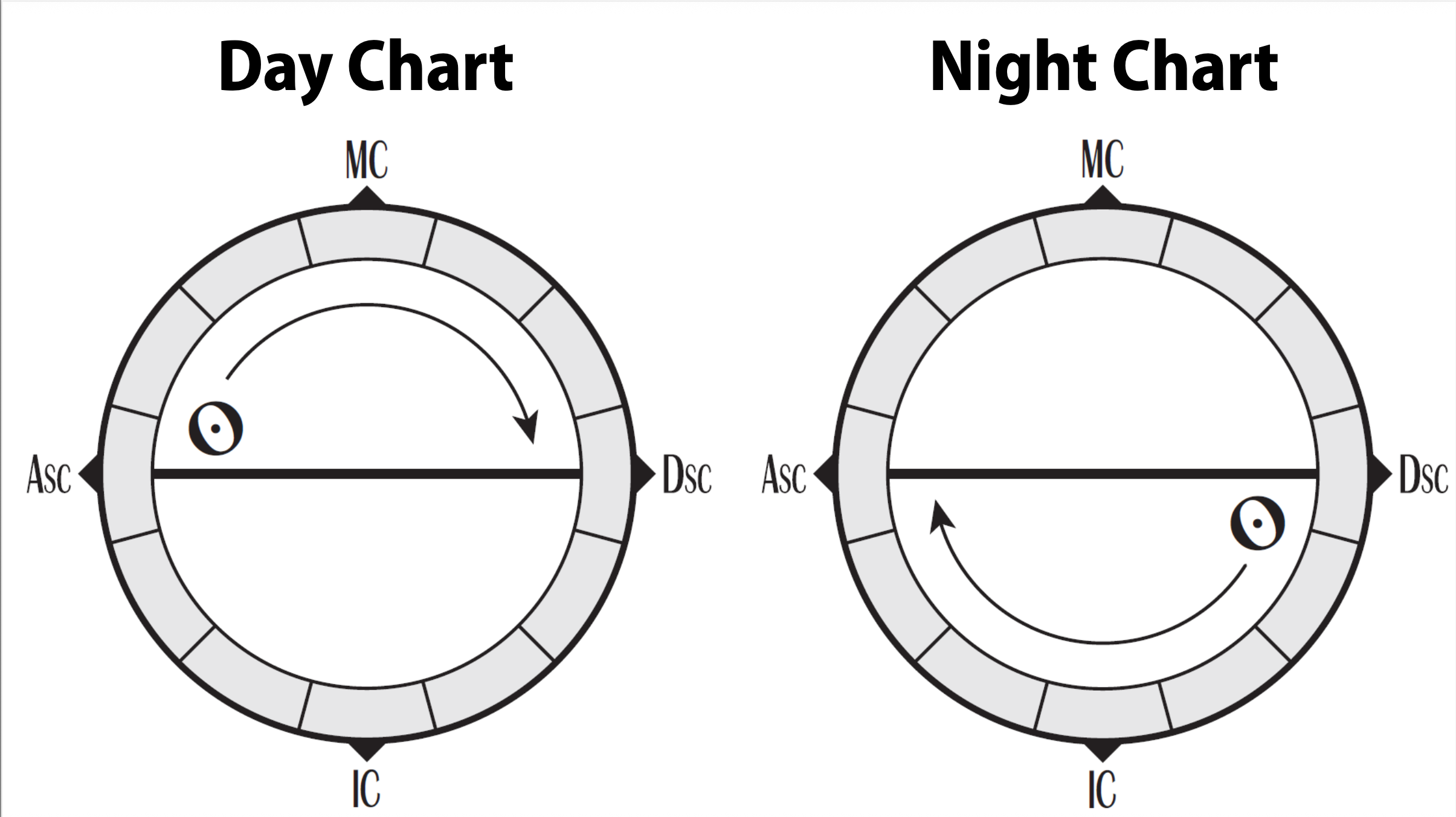
This graphic was produced by Chris Brennan of The Astrology Podcast as part of a publicly-available PDF created for Episode 274: Sect in Astrology: Day and Night Charts
If your Sun ☉ is above the ASC/DSC axis, you have a day chart! 🌞
This means that according to sect, with a Day Chart:
Your sect light is the ☉ Sun 🌞
Your most helpful benefic (helpful planet) is ♃ Jupiter 🍀
Your most detrimental malefic (challenging or harmful planet) is ♂️ Mars ⚔️
Your most constructive malefic is ♄ Saturn 🪐
If your Sun ☉ is below the ASC/DSC axis, you have a night chart! 🌝
This means that according to sect, with a Night Chart:
Your sect light is the Moon 🌝
Your most helpful benefic (helpful planet) is ♀️Venus 🌹
Your most detrimental malefic (challenging or harmful planet) is ♄ Saturn 🚧
Your most constructive malefic is ♂️ Mars 💪
While there are very important mitigating factors, sect can often be a quick way to see what your most helpful astrocartography line(s) might be, especially if your benefic of sect is domicile or exalted in your birth chart!
Speaking of which…
Step 3: Check for basic Essential Dignity + Debility (What signs are your planets in? Do they like it there?)
Understanding how happy or frustrated each planet in your birth chart is at their core is absolutely a must in terms of understanding your best ACG lines because your astrocartography map’s planetary lines will carry the energy of your natal planets.
Especially look out for planets in Fall.
Having a planet in fall isn’t the end of the world (I promise!), but it’s important to know because unless there are major mitigating factors, a planet in fall typically won’t feel good on an angle even if it’s a “good” planet like Venus or Jupiter (you’ll likely want to avoid fallen planetary lines in your astrocartography map or will naturally prefer others) and typically won’t behave like the general lists you’ve seen on social media.
This is a common point of confusion for beginners, especially when looking at ACG lines with the luminaries (Sun/Moon) and benefics (Venus/Jupiter) as well as Mercury that “should” be good.
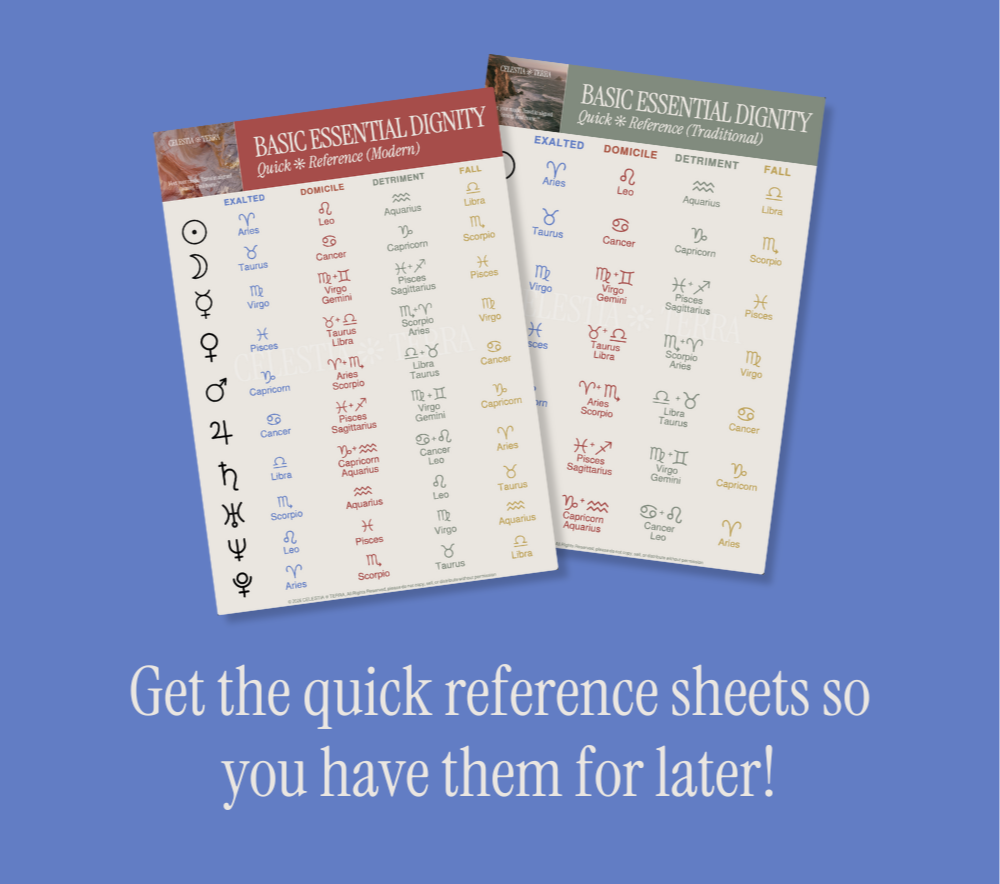
Here is list of planets in fall, detriment, domicile (rulership), and exaltation according to Hellenistic astrology:
Fall (unable to do their job well with the tools they have—likely good to avoid that planet’s astrocartography lines if you have a placement below):
☉ Sun in Libra ♎︎
☽ Moon in Scorpio ♏︎
☿ Mercury in Pisces ♓︎
♀️Venus in Virgo ♍︎
♂️️Mars in Cancer ♋︎
♃ Jupiter in Capricorn ♑︎
♄ Saturn in Aries ♈︎
Detriment (struggling a bit, but not the end of the world):
☉ Sun in Aquarius ♒︎
☽ Moon in Capricorn ♑︎
☿ Mercury in Sagittarius ♐︎ (or Pisces ♓︎, but that’s also Fall)
♀️ Venus in Scorpio ♏︎ or Aries ♈︎
♂️️Mars in Libra ♎︎ or Taurus ♉︎
♃ Jupiter in Gemini ♊︎ or Virgo ♍︎
♄ Saturn in Cancer ♋︎ or Leo ♌︎
Home/Domicile (best, according to Hellenistic Astro):
☉ Sun in Leo ♌︎
☽ Moon in Cancer ♋︎
☿ Mercury in Virgo ♍︎ or Gemini ♊︎
♀️Venus in Taurus ♉︎ or Libra ♎︎
♂️Mars in Aries ♈︎ or Scorpio ♏︎
♃ Jupiter in Sagittarius ♐︎ or Pisces ♓︎
♄ Saturn in Capricorn ♑︎ or Aquarius ♒︎
Exaltation (extra-resourced, maybe a bit intense!):
☉ Sun in Aries ♈︎
☽ Moon in Taurus ♉︎
☿ Mercury in Virgo ♍︎ (also domicile!)
♀️Venus in Pisces ♓︎
♂️Mars in Capricorn ♑︎
♃ Jupiter in Cancer ♋︎
♄ Saturn in Libra ♎︎
Check for mutual reception, which is when planets are exchanging signs (ex: Sun in Cancer while also having Moon in Leo). Mutual reception can give planets in fall or detriment a leg up!
TIP: Planets in fall that are retrograde in the natal chart (look for an R or ℞ next to the planet symbol in your birth chart) tend to be more inwardly expressed rather than outwardly experienced, which can also help.
While there are a lot of other rules to dignity and debility, this is a good place to start!
Step 4: Check your aspects (especially the super-close ones)
Aside from fallen planets (see Step 3), strong aspects in your birth chart can often be the reason behind why a “good” planetary line might feel not-so-good (or vice-versa)!
This is one of the reasons starting with your natal chart before diving right into cruising around your map is absolutely essential!
Any strong aspect, especially conjunctions, trines, sextiles, squares, and oppositions will affect the energy of your planetary lines, tying the stories of those planets together and including the energy of the aspect.
Most free natal chart services will show aspects with the symbol and orb (how close/strong the aspect is) in a list or table, like this:
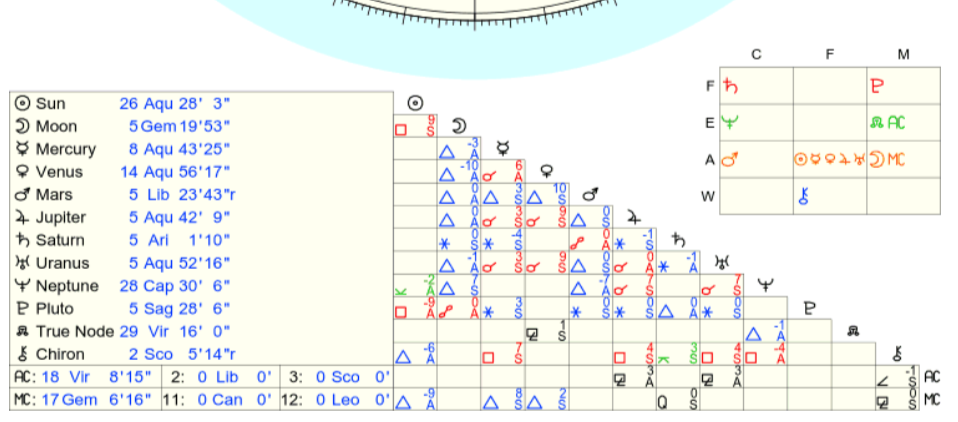
This is from astro.com (Astro Dienst)—the aspect table (bottom-right) is shows a number (the orb, or how strong the aspect is), the symbol (what type of aspect it is [see below]), and whether it is Applying (A, generally stronger, especially the closer to 0 it is) or Separating (S, generally experienced as weaker because the aspect has already peaked).
Aspect Orbs (which aspects to prioritize):
Take note of any aspects that are within and orb of 0-3 degrees (consider 0-5 degrees with the Sun/Moon). A 0-3 degree aspect will be loud in your chart and map, even if separating. 0 degrees is the strongest, it’s like golf rules. All aspects matter, but this is a good place to start!
Here is a list of aspects to check for in your natal chart and their symbol and basic meanings:
☌ Conjunction (combination of energy): Two planets are next to each other, a combination of energies. Whether this is supportive, challenging, or just a combination depends on the planets involved.
△ Trine (typically very supportive; easy flow of energy): Two planets are ~ 120 degrees apart. These will be in the same element (fire, water, earth, air) and tend to be very supportive, even if with a malefic planet—however, a malefic planet is typically still malefic, it is just more likely to express helpfully (depending on the rest of the chart details, as always).
⚹ Sextile (typically supportive but more as potential—activation is often needed to benefit): Two planets are ~60 degrees apart, typically offering potential or opportunity, kind of like an acquaintance setting you up with the recruiter at their company.
☐ Square (typically challenging and dynamic; uncomfortable): Two planets are ~90 degrees apart, typically requiring work to alchemize the tension into something supportive and productive. Not an easy nor restful energy. NOTE: Traditional Hellenistic astrology considers any aspect, including squares and oppositions, from a benefic (Jupiter/Venus) to be helpful in most cases. Squares occur between the similar modes (cardinal, fixed, or mutable) and tend to generate a lot of energy and urge us to express it to relieve the pressure.
While this can be uncomfortable, squares (and oppositions) are what typically spur us to action and therefore often support the most productive change and forward movement in our lives.☍ Opposition (typically challenging and dynamic; uncomfortable): Two planets are ~180 degrees apart or directly opposite each other in the birth chart. Many astrologers consider this to be the most challenging aspect. I personally think that oppositions may be a little less challenging than squares due to being between compatible elements, which isn’t the case with squares. Oppositions can often be worked with productively by finding a balance between the two placements.
For example, if you have a Sun square Saturn aspect, keep in mind that instead of just Sun lines, you have Sun-square-Saturn lines, which will be more dynamic and likely unpreferable since your ability to shine is in a challenging, grit-in-the-gears relationship with boundaries and restriction.
(Remember that in Step 3 we learned that Saturn is in fall where the Sun is exalted, so there is naturally a conflict-of-interests in this aspect, both because it’s a square and because of the two planets involved)
TIP: Consider sect! Squares are inherently a more challenging or dynamic aspect; however, this example aspect might especially be a red flag if you have a night chart, since Saturn is your more challenging malefic.
NOTE: As with everything in astrology, there are more details, but for the purpose of getting you going for the first time around your natal map, these are a great place to start! Just know there are more factors for basically every step I’m sharing here, which is part of the benefit to booking an astrocartography reading!
Step 5: Consider the themes for each planet and planetary line+ understand the angles!
Each planet offers certain themes, and I’ve included keywords to work with for each planet + its associated planetary line below:
☉ Sun: ego, identity, sense of self, vitality, willpower, how we aspire to shine in the world
☽ Moon: emotions, needs, desires, intuition, instincts, how we feel, how we care
☿️ Mercury: mind, how we communicate and think, learning, magic
♀️Venus: values, luxury, art, aesthetics, pleasure, how we love + attract
♂️ Mars: energy, drive, what we protect, how we take action; can be violence/attacks
♃ Jupiter: luck, optimism, confidence, abundance, expansion, how/what we believe
♄ Saturn: boundaries, structure, discipline, mastery, how we commit
♅ Uranus: change, authenticity, technology, surprises, how we innovate
♆ Neptune: creativity, spirituality, altered states, inspiration, how we dream; can be addiction, deception, lack of clarity
♇ Pluto: power, control, passion, catharsis, how we transform
(NOTE: Pluto has an alternate modern symbol with no unicode yet that looks a bit like Venus with a collar around the circle on top)⚷ Chiron: where we are wounded or need to heal; how we may uniquely support or help heal others once we’ve begun to integrate our wound
North Node (☊) + South Node (☋): Volume up (or what you’re striving for/want more of) or volume down (or what comes easily/comfort zone/what calls to be released).
Each planetary line or astrocartography line also has an angle—here’s what each angle means in locational astrology:
ASC or AC is short for Ascendant, meaning you, your physical body, and/or the energy radiating from you. In astrocartography, we look to the ASC to see how you will generally experience a place or how being there will likely feel for you. Any planets relocated to the first house will be immediately apparent to others interacting with you, and you might take on a different energy based on the planetary ruler of your ascendant. Putting a planet on the ASC (going to or near a planet’s AC line) is like letting it drive you around in its vehicle of choice or wearing it like an outfit.
Fun fact: Every planet has a favorite house, and Mercury’s is the first house, also referred to as “the helm.”DSC or DC is short for Descendant, meaning other people, the energy coming towards you, and/or the energy you embody in your important 1-on-1 business, romantic, and platonic relationships with others. In astrocartography, we look to the DSC to see how others might respond to you in a location, and/or for more information on love and partnerships. Putting a planet on the DSC (going to or near a planet’s DC line) is like setting a radio dial for your close relationships to that planet’s frequency, or dating it.
MC stands for “medium coeli” or Midheaven, meaning the highest, most visible and public point in the chart. Often associated with the career, although not everyone is most visible in their career. Putting a planet on the MC (going to or near a planet’s MC line) is like having it on display for the world to see, or like having it as your closest collaborator in your public life.
IC stands for “imum coeli” or Nadir, meaning the lowest, most private point in the chart. In astrocartography, we look to the IC to tell us more about the home. Putting a planet on the IC (going to or near a planet’s IC line) is like having it as a roommate or live-in landlord.
Next, combine the planet and angle meanings to understand your planetary lines and parans:
Sun (ego, identity, how we shine or want to shine) + MC (highest/most visible point/career) = shining in our career; career recognition; favorable circumstances for leadership in the workplace.
BUT… your mileage may vary for example if you have a fallen sun (Libra), harsh aspects from a malefic to your sun, or the ruling planet of the sun in a tough house → this is why we look at your natal chart before we even touch the map!
Extra Credit: To dig deeper, review which sign each planet is in (you did this in Step 3) to see how they’re expressing those planetary themes (for foundational information on the zodiac signs by Chani Nicholas [whose work I love and admire], click here).
Which house you find each planet in in your birth chart will help you understand where they’re acting out their role in. See the house signification chart in Step 6 for which house rules each area of life!
Because each traditional planet rules 1 or more sign, you can also look to the houses that planet rules for more information about the areas of life it’s touching (listed in Step 3 under domicile).
TIP: You can look to the planetary ruler of the sign of any house of your natal chart for more information on that area of life. This is super-helpful if you have empty houses, which does not mean that area of life is somehow lacking, nor does it mean that you don’t have any of that zodiac sign’s energy in your life.
A note on Parans:
Parans or paranatellontae (aka planetary crossings) are a horizontal line—across the entire globe—formed where two planetary lines cross.
Because each planetary line is comprised of a planet and an angle, you’ll end up with two planets and two angles in a paran, for example you might have a Venus DSC-Jupiter MC Paran (if you’re god’s favorite).
Everyone has different parans because they are formed by your unique combination of planetary lines! (You might technically have the same paran as someone else somewhere in your map, but it’s not guaranteed and would probably be in a different location)
The energy of a paran is much smaller in range than planetary lines—70 miles north or south of the line—but parans can often be the most- or second-most important energy in an area (depending on whether planetary lines are in range/orb).
I think of planetary lines as the cake and parans as the frosting…
For my birthday, I love a carrot cake. I have very strong opinions about it being a carrot cake, and what ingredients are and aren’t in it (no thank you, raisins). It’s important to me that it’s cake, and that it’s carrot cake. Those are the planetary lines.
I’m also super-opinionated about cream cheese frosting on carrot cake. It makes a big difference to me, and I also don’t like it to be too sweet—however, would I eat a carrot cake with buttercream frosting over a vanilla cake for my birthday? Yes. Because the carrot cake (planetary lines) is more important to me than the frosting (parans).
Also, not to take the anology too far, but I would happily eat a good cream cheese frosting right outta the container (tupperware or store-bought) and dip other stuff in it if I didn’t have any cake on hand. That’s the power of a good paran.
On AstroClick Travel, you will see information about crossings or parans when you click in a location but it’s important to know that they’re really only relevant 70 miles north or south of the horizontal line formed at the crossing, which might be a bit fiddly in terms of figuring it out from the latitude on the map.
Of course, if you’re also in the area (within 600 miles or less) of the place the two planetary lines cross—where the paran is formed—the energy will be stronger because you’re experiencing the planetary lines in addition to the parans.
So, why am I including these super-important parans as a note and not as a required step? Because they’re not always super-accessible in free software, but I want you to know they exist, how important they are, and what they mean!
Step 6: Review what you can & cannot change in astrocartography
What you cannot change with astrocartography:
Your planets’ placements in signs. You will always have your planets in the same signs, it’s not possible to outrun your Sun in Libra or your Venus in Virgo. You take them with you everywhere you go! On the other hand, if you have Jupiter in Sagittarius or the Sun in Leo, that’s also with you for life—most people have a mix of helpful and challenging things in their birth charts, so no stress! We’re all working with what we’ve got.
Aspects between planets. If you have a Sun square Saturn or a Mars opposite Moon, that’s coming with you wherever you go.
Your natal chart. Your natal chart is your cosmic blueprint, and in the immortal words of Dwight Schrute* in Juno, “That ain't no Etch-a-Sketch. This is one doodle that can't be undid, Homeskillet.” While there’s huge shifts possible with relocation in terms of your lived experience of your natal promise, most astrocartographers agree that there is always going to be at the very least a faint echo of even the parts of your birth chart that do shift during relocation (like natal house placement), because it’s your birth chart. However, arguably the longer you spend somewhere else, the more you’re embodying your relocated chart.
*yes, I know.
What you can change with astrocartography:
The rotation of your natal chart: While your planets stay put in their signs and houses, your natal chart becomes the wheel of fortune in astrolocality, and you can spin it any which way. If you have a stellium (especially of nice planets), you can strategically position it in a house/on an angle based on what you’re looking to do. For instance, maybe you have a nice 5H stellium natally but you really want to emphasize love and partnership—we might look to where in the world your nice stellium lands in the 7H, ideally with your benefic of sect right on the DSC. This also brings us to the next point, because if any sign can be in your first house, that includes changing your ascendant!
Your angles (AS/DS/MC/IC): Your angles are completely in play with relocation astrology, which means the stories happening around you/your ASC (especially the energy coming from you/how others receive you and perceive you), your 1-on-1 relationships and major partnerships of all kinds (business, romantic, platonic)/your DSC, your career and public life, or where you’re most visible/your MC, and your home life, roots, and family legacy (IC) can all change when you move or travel! Astrocartography is largely based on planetary angularity, so positioning your best planets on or near an angle that corresponds to your current highest priority is a big strategy.
Aspects from planets to angles: The next logical realization is that if your chart rotation can shift and your angles can be any degree in any sign, that means that new aspects from your planets to the relocated angles can form! One of the big things to look out for in relocated charts, aside from a general understanding of the houses and angles as they shift, is new aspects, especially to the ASC or MC (or depending on the main focus for relocation/travel). A nice supportive trine or even sextile from a happy benefic to the ASC and/or MC can be super-helpful; similarly, a harsh square or opposition from Saturn, Mars, or Pluto can be tough.
To understand what I mean about rotating your natal chart, you’ll need at least a basic understanding of the house meanings in astrology—the image below focuses on the most traditional meanings of the houses.
Keep in mind that life back then was generally harsher and more intense, especially in a health context (if you have placements in your 8th house, it’s not always about death).
I would add that the 12th house also deals with spirituality and often psychic ability or mediumship (also unseen).
As an interesting note, many “helping professions” like therapy and medical professionals (both western and alternative) have placements in the 6th, 12th, and 8th houses, including working in hospitals, treatment centers, and in hospice. Context matters!
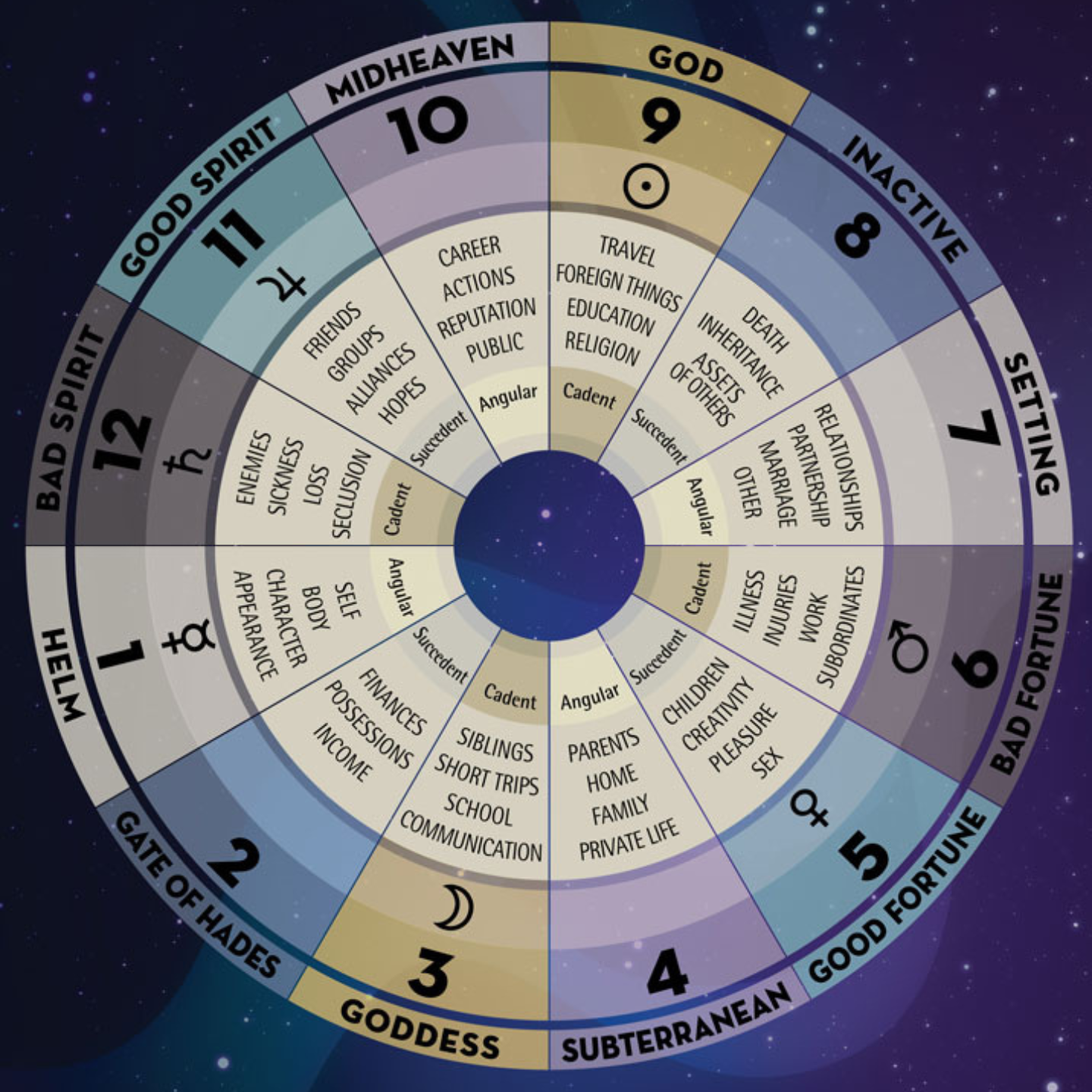
This is just an overview, but a deeper understanding of astrology will lead to a deeper understanding of your natal map. You can see where each planet has its “joy” in this graphic, which also makes it happier! (I’ve always found it funny Saturn has his joy in the house of bad spirit.)
The image above was created by Chris Brennan of The Astrology Podcast and used for two super-in-depth The Astrology Podcast (by Chris Brennan) episodes discussing the 12 houses: Houses 1-6 (Episode 1) + Houses 7-12 is linked below it!
Just from looking at the house meanings, you can begin to understand how shifting planets out of certain houses or into others might have a noticeable influence on your day-to-day life and how you feel in a place.
For instance, did you know that Winona Ryder has a natal 12H Sun? For a celebrity, that can be a little unusual or even potentially challenging (with a 12H sun, your ego/identity/the way you naturally shine or want to shine is unseen).
Interestingly, when her family moved from Minnesota to California, she shifted her Scorpio Sun into the first house, plus put her Venus and Neptune on the ASC (in orb for Neptune ASC at least) as well as her Moon on the IC. It’s no wonder her career in film and TV took off there, and that she maintains two homes in the area!
Speaking to the “residual” house vibe I mentioned in Step 6, it’s interesting that in recent interviews, Winona talks about how she didn’t have “the look” when she was coming up in Hollywood (note the Scorpio Venus [detriment] in the 12H + 12H Mercury ruling her 7H/DSC)—while most of us would disagree since she’s become one of the poster children for the look of that time (although admittedly the alt version of it), she still feels and thinks that she wasn’t desirable or considered attractive.
Sometimes these residual stories might also be about healing our childhood wounds and being open to the energy shifting around us when we relocate.
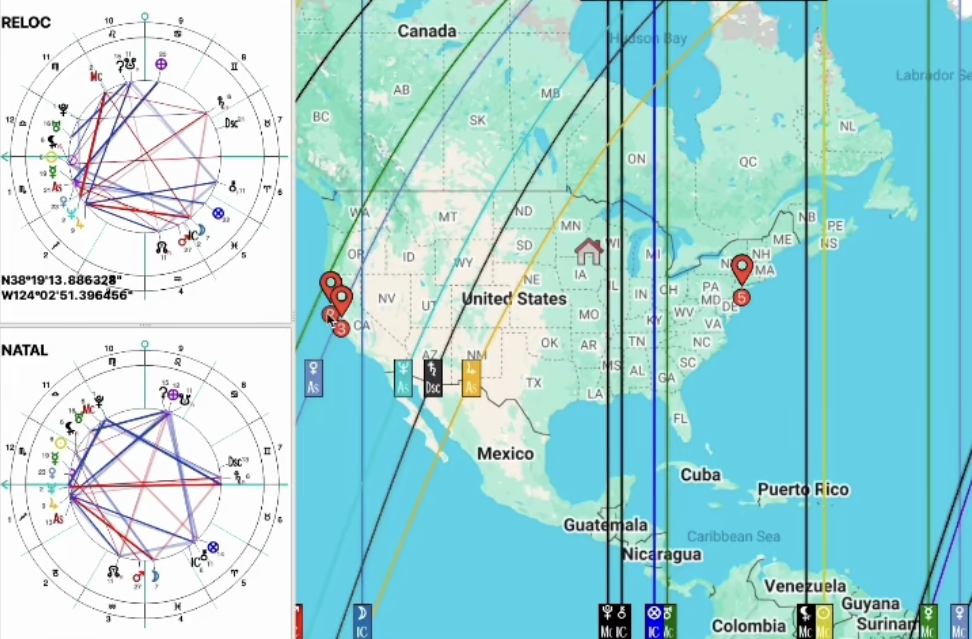
Relocation case study: Winona Ryder
To see how her relocated chart changes across the country and how that plays out for her, watch this quick video!
Step 7: Consider what your current priorities and limitations are
What areas of the world draw you in? Which do not?
Which locations compatible (or not) with you due to weather, politics, cost of travel there, ability to work, and/or visa limitations?
What areas of life are most important to you at the moment? Ideally, choose one to focus on—here are the most common with clients, along with some tips to refer back to once we get to diving into your astrocartography map and relocated chart in Steps 9-10, but start by looking at your natal chart for more information on the topics below:
Career (look to MC + 10th house, which planets are there and which signs rule the houses [plus where the ruling planets of those signs are, if somewhere else], plus any houses related to your career of choice). Generally, you might look to put a benefic on the MC and/or move a beneficial stellium to the 10th house, but it depends on the chart!
Love & Partnerships (look to the DSC + 7th house, which planets are there, ruled by which signs, ruled by which planets?). Generally, you might position a benefic on the DSC and/or move supportive planets to the 7H for more action in that area of your life.
Health (look to ASC + 6th house, which planets are there, etc + what aspects are being made and by which planets to the ASC and any planets in the 6H/6H planetary ruler). I am not a medical astrologer, but consulting one can be really helpful for health inquiries! In general, a benefic-trined ASC, benefic-ruled ASC, and supportive planets in the 6H tend to support health. Consider also 12H as it is associated with mental health, which often plays a role. It should be abundantly clear this is not medical advice and I am not a medical provider, but just to clarify that if you’re having health issues, please consult your medical provider, not an astrolocartographer! Often, negative health outcomes that are acute [short-term] are associated with a challenging transit or progression moreso than a location, but that also depends.
Community (look to the 11H, planets there, aspects, the sign ruler of the 11H and where that planet is in the relocated chart). Generally, placing benefics and social planets and/or supportive planets in the 11H can be supportive of community. Keep in mind the ASC + ruler, since how we come off to others can be important for finding and fostering community!
Feeling at home (look to the IC + 4th house for clues). Generally, placing a benefic on the IC can be really lovely—Moon IC [assuming the moon is relatively happy] is also a classic option to consider, as is Sun IC, especially in retirement where the sun isn’t necessarily needed elsewhere. In retirement, considering the 11th house as well can be lovely to support a sense of community. The 3rd house is also helpful to look to in astrocartography as it represents (among other things) the local neighborhood, so it’s a factor in feeling at home and enjoying where we live too!
Step 8: Pull up your astrocartography map for free online—here’s how:
While I use professional software that offers more detail, I absolutely used free software online when I first learned about astrocartography (before training in it) and I know that some working astrologers even use AstroClick for paid readings.
AstroClick Travel’s free online personalized Astrocartography Map tool:
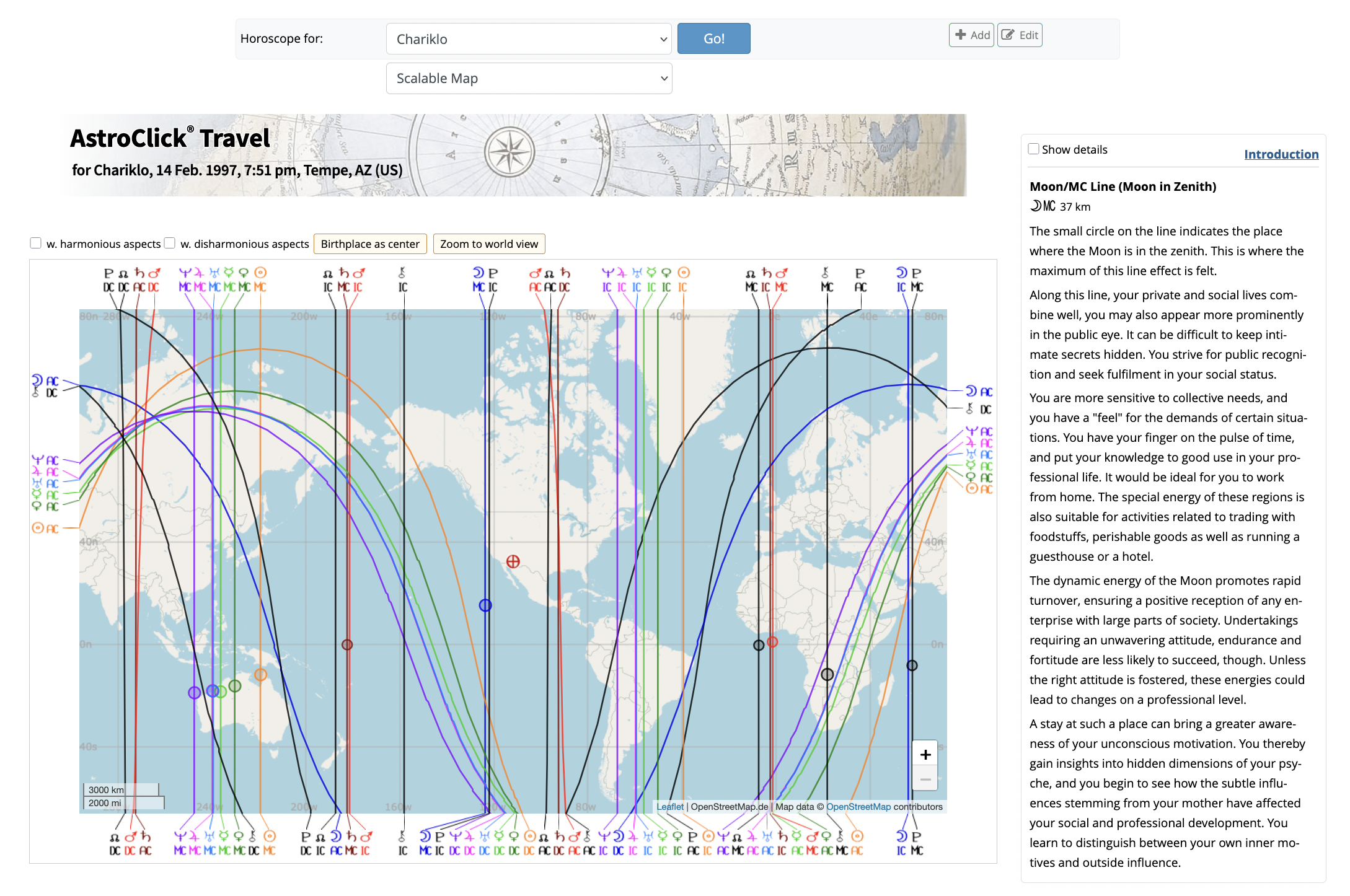
To pull up your map and get exploring around the globe, click the image above to visit AstroClick Travel for your free astrocartography map with interpretations!
You’ll need to make an account, but it’s totally free and I promise it’s worth it. You can save different birth data, so it’s easy to flip back and forth between you and your partner/child/bestie if you’re planning a trip or relocating together.
On AstroClick Travel, each line has a planet symbol and angle (you know how to read those now)—they’ve also color-coded the lines for you so it’s easier to tell where each of your four Jupiter lines are, for instance!
TIP: The interpretation on the right will show you the planet’s name and symbol when you click near a line if you forget.
Step 9: Navigate your map, collect data, follow your intuition, and look for supportive zones
This is the part you’ve been waiting for! Here are a few additional tips to help you get going:
Start with where you currently live. What lines are in the area? Note the angle as well as the planet. What parans? Do you feel like you’re experiencing those energies? What is your relocated chart like there? Is your relocated ASC different from your natal rising sign?
Where have you traveled before? What lines are nearby? Note the angle as well as the planet. Did you feel like you embodied or radiated the energy of the sign in your relocated first house there? If not, where is the ruling planet?
Where are you feeling drawn to? What lines are nearby? What would your life be like there based on your relocated chart, lines, and parans? What’s your relocated Ascendant?
Astrocartography planetary lines have a pretty big distance of influence—arguably up to 600 miles on either side of the line, with the strength decreasing as you get further away.
To reiterate, parans have a range 70 miles north or south of the line, with decreasing influence the further you get from the horizontal line.
Jim Lewis always said west [of the line] is best; however, it depends on the planet and what you’re trying to accomplish. If it’s a malefic, you might not want it in an angular house or with a lot of obvious influence in your life.
Most people don’t want the experience of living DIRECTLY on a planetary line—you can read more about this in this article by Moses Siregar III. It’s really important to understand that the closer you are to a planetary line, the louder both the negative and positive (or preferable and unpreferable, or supportive and challenging) manifestations of the planet involved will be. Not everybody wants to live life like Keith Richards, you know? Some people want more of a cats-in-a-castle Enya vibe. Sometimes finding a supportive place is as much about being away from lines or parans as near them, especially if you’re looking for minimum action at this point in your life, and/or your chart is particularly intertwined.
Speaking of which, most people don’t enjoy locations where there are a bazillion lines that overlap, which forms an energy vortex that can be agitating and overwhelming.
Now that you know a little about aspects, consider checking to display harmonious and unharmonious aspects on the map. Are you near any of them? Can you feel that combination of energy?
Step 10: Consult your relocated chart in promising places—this is the blueprint for your story in another place!
Most free astrocartography softwares offer easy ways to look up your relocated chart. Here’s a free tool for relocation charts.
Relocated chart assessment is a little more complex, because it requires an understanding of natal chart synthesis that you may not have yet.
You can skip it for now (just know it’s important too), or begin with:
Natal chart orientation:
What is the ASC? Where is the ASC ruler in the chart? Is it happy? Is it a benefic or malefic? What area of life does it rule over?
What planets are in what houses? What area(s) of life will that activate? Is that helpful to your current goals and priorities? Is the most important area of life for your current priorities ruled by benefics or malefics?
Where are the angles (ASC/DSC/MC/IC)?
Are helpful planets near them or aspecting them?
What planet rules the sign they’re in? How is that planet feeling? Where is that planet [in which house]?
What is the nature of the sign on each angle? Is that aligned with the energy you prefer in those areas of life?
Aspects:
Are there any strong, new aspects to the angles?
NOTE: A relocated chart is translating the exact moment of your birth to different locations around the world.
So, if you were born at noon in New York City and you’re manually generating a relocated chart for Minneapolis, you’ll want to adjust the birth time to 11am. This means that depending on where you’re looking, your relocated chart can even show an entirely different date. If math isn’t your forte (or time zones are a headache for you), use a date and time converter to check.
TIP: If you use an astrology app that includes real-time transit information (and/or weekly forecasts), it can be really enlightening to look both at your natal chart info and your relocated chart info if you’re living somewhere other than where you were born, especially if you’ve been there a long time!
I pay for the CHANI app (not sponsored, it’s just truly my fave—and I listen to the weekly forecast for my natal and relocated rising sign, which is super-helpful and interesting to compare. I just manually adjust my birth time and location using the method laid out above.
A note on timing (it’s important!) + a few reasons why your “good” lines might feel bad:
Our experience of life is impossible to separate from the concept of both place and time. We are always somewhere, and time is always ticking.
The heavens didn’t stop moving when we were born—we’re all always going through progressions and transits in addition to experiencing our all-the-time natal map and birth chart.
While timing is an essential piece, knowing your all-the-time natal map energy is also helpful and key. It’s the backdrop against which all of your progressions and transits happen.
For now, I’d recommend keeping in mind that if you had a totally rotten time on one of your lines that should be supportive, there are a few possibilities:
You were going through a really rough progression and/or transit (and/or we were collectively going through a rough transit)
You were in a challenging profection year with tough planets relocated into the affected house(s) (another space x time consideration)
There’s something in your natal chart that might be a bit more advanced to parse out that’s influencing the line/area
There’s something up in your relocated chart, like a hard aspect to the ascendant or MC (or other relevant angle) from a malefic, or even just plopping a fallen planet into an angular house (1/10/7/4)
There might be a rough paran in the area you aren’t seeing
The free software might not be 100% correct or detailed enough to reflect everything happening in the area (unfortunately it’s just true)
Your birth time is incorrect (I can’t tell you how important your correct birth time is in terms of map accuracy!)
Obsessed and want to learn more?
Check out my bookshop.org resource list for getting started in astrology + astrocartography! I don’t believe in gatekeeping, this is the good stuff.
[This one is an affiliate link—the only one, because I love supporting independent bookstores!]
I hope this was helpful!
If you’re looking for trained support* exploring + understanding how to use your natal map to support your priorities and goals…
*I am certified by Helena Woods and in her Reader Directory—that may be how you found me. If so, hello! 👋
Every typo (regrettably there’s likely at least one I haven’t caught) and word on this page was hand-written by a human, one letter at a time.
I do not use AI at any point in my astrocartography practice or in my life in general.
Astrocartography by humans for humans forever! xo, Charlie
